#' Calculate p-value from a chi-squared test with varying sample sizes
#'
#' This algorithm will start with an initial sample size (`n_start`) and perform a chi-squared test
#' with a vector of counts equal to `n * probs`. This will repeat increasing the sample size by
#' `n_step` until the p-value from the chi-squared test is less than `p_stop`.
#'
#' @param vector of cell probabilities. The sum of the values must equal 1.
#' @param sig_level significance level.
#' @param p_stop the p-value to stop estimating chi-squared tests.
#' @param max_n maximum n to attempt if `p_value` is never less than `p_stop`.
#' @param min_cell_size minimum size per cell to perform the chi-square test.
#' @param n_start the starting sample size.
#' @param n_step the increment for each iteration.
#' @return a data.frame with three columns: n (sample size), p_value, and sig (TRUE if
#'         p_value < sig_level).
#' @importFrom DescTools power.chisq.test CramerV
chi_squared_power <- function(
        probs,
        sig_level = 0.05,
        p_stop = 0.01,
        power = 0.80,
        power_stop = 0.90,
        max_n = 100000,
        min_cell_size = 10,
        n_start = 10,
        n_step = 10
) {
    if(sum(probs) != 1) { # Make sure the sum is equal to 1
        stop('The sum of the probabilities must equal 1.')
    } else if(length(unique(probs)) == 1) {
        stop('All the probabilities are equal.')
    }

    n <- n_start
    p_values <- numeric()
    power_values <- numeric()
    df <- ifelse(is.vector(probs),
                 length(probs) - 1,
                 min(dim(probs)) - 1) # Degrees of freedom
    repeat {
        x <- (probs * n) |> round()
        if(all(x > min_cell_size)) {
            cs <- chisq.test(x, rescale.p = TRUE, simulate.p.value = FALSE)
            p_values[n / n_step] <- cs$p.value
            pow <- DescTools::power.chisq.test(
                n = n,
                w = DescTools::CramerV(as.table(x)),
                df = df,
                sig.level = sig_level
            )
            power_values[n / n_step] <- pow$power
            if((cs$p.value < p_stop & pow$power > power_stop) | n > max_n) {
                break;
            }
        } else {
            p_values[n / n_step] <- NA
            power_values[n / n_step] <- NA
        }
        n <- n + n_step
    }
    result <- data.frame(n = seq(10, length(p_values) * n_step, n_step),
                         p_value = p_values,
                         sig = p_values < sig_level,
                         power = power_values)
    class(result) <- c('chisqpower', 'data.frame')
    attr(result, 'probs') <- probs
    attr(result, 'sig_level') <- sig_level
    attr(result, 'p_stop') <- p_stop
    attr(result, 'power') <- power
    attr(result, 'power_stop') <- power_stop
    attr(result, 'max_n') <- max_n
    attr(result, 'n_step') <- n_step
    return(result)
}

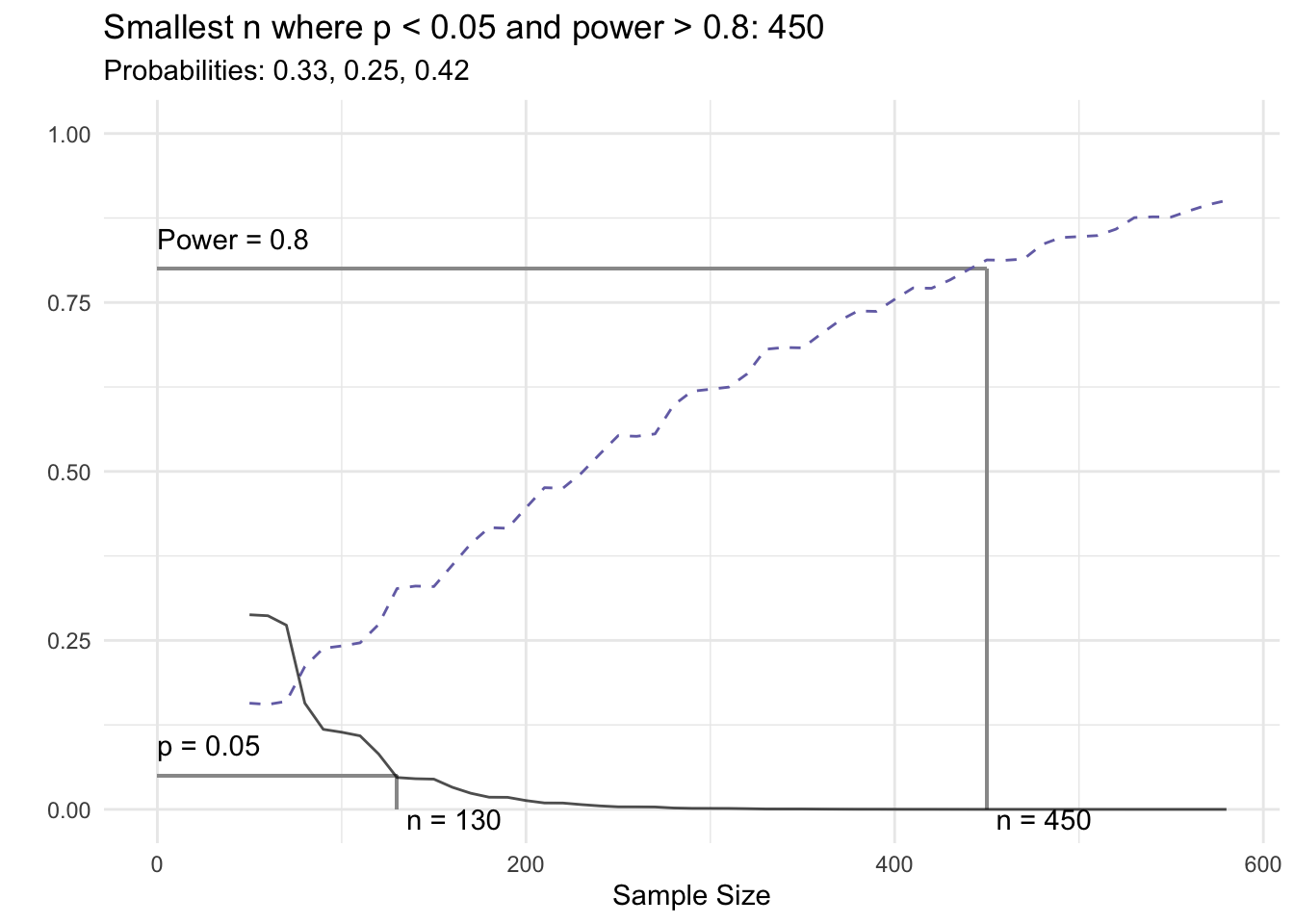
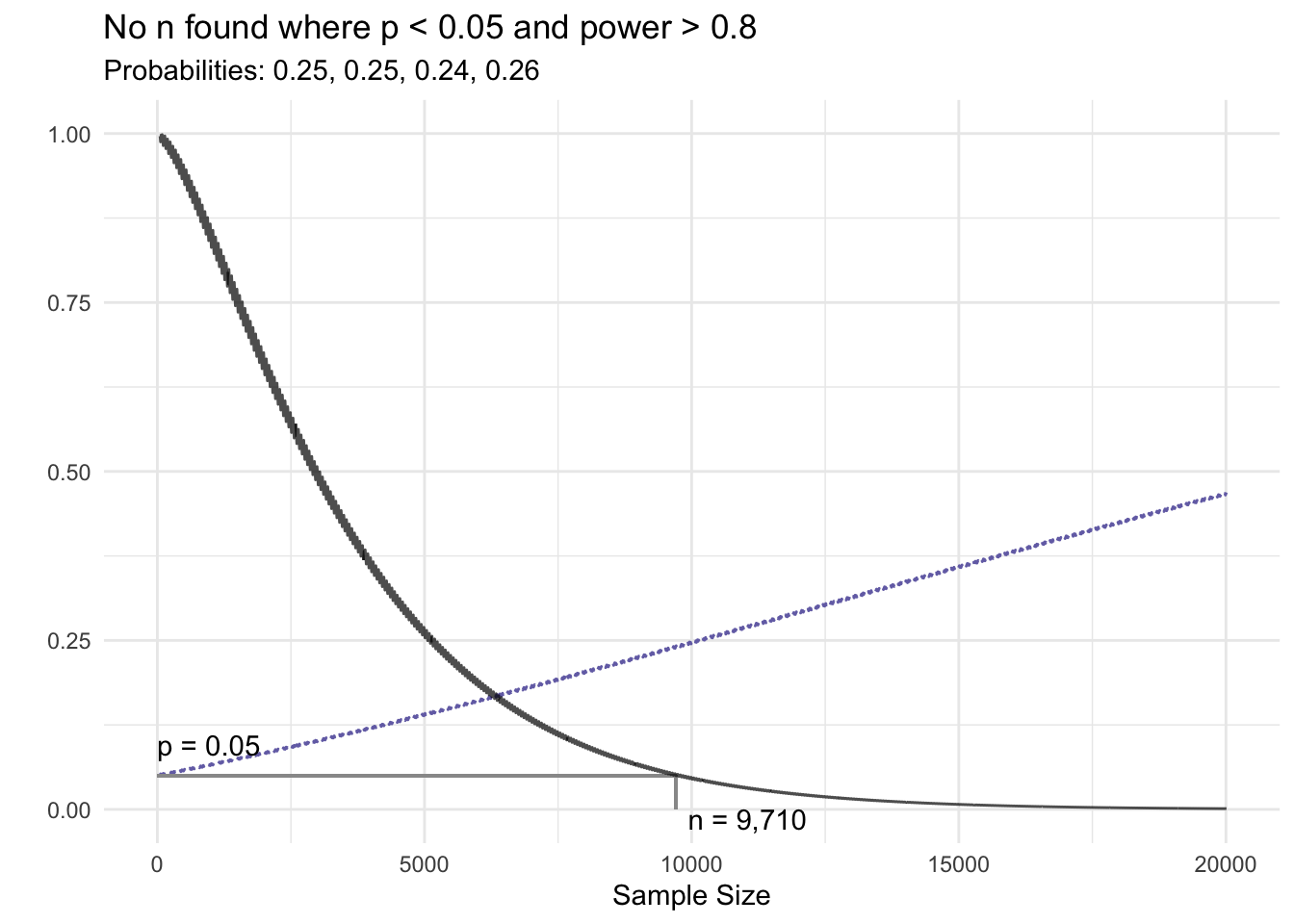
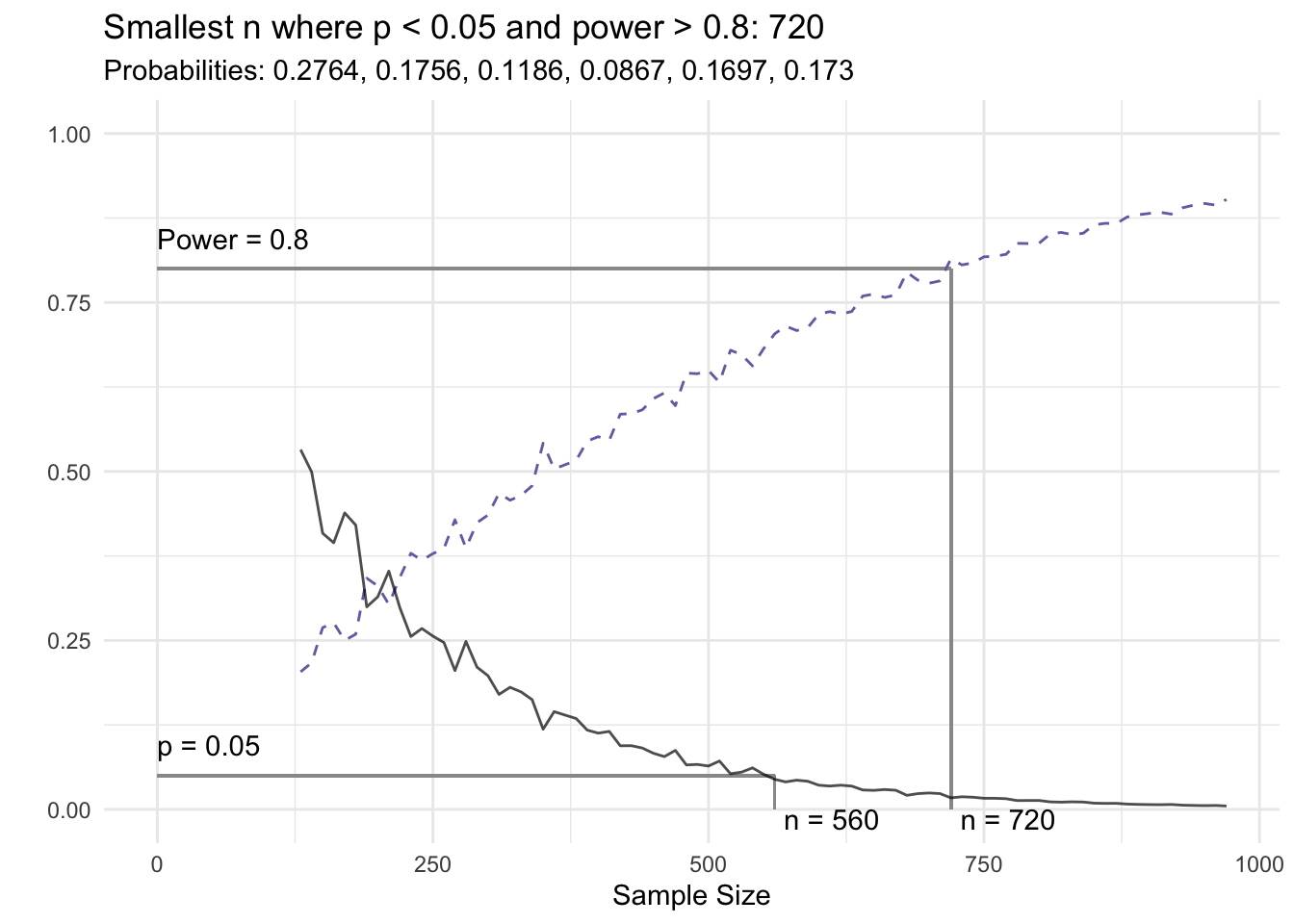
#' Plot the results of chi-squared power estimation
#'
#' @param x result of [chi_squared_power()].
#' @param plot_power whether to plot the power curve.
#' @param plot_p whether to plot p-values.
#' @param digits number of digits to round to.
#' @param segement_color color of the lines marking where power and p values exceed threshold.
#' @param sgement_linetype linetype of the lines marking where power and p values exceed threshold.
#' @param p_linetype linetype for the p-values.
#' @param power_linetype linetype for the power values.
#' @param title plot title. If missing a title will be automatically generated.
#' @parma ... currently not used.
#' @return a ggplot2 expression.
plot.chisqpower <- function(
        x,
        plot_power = TRUE,
        plot_p = TRUE,
        digits = 4,
        segment_color = 'grey60',
        segment_linetype = 1,
        p_linetype = 1,
        power_linetype = 2,
        title,
        ...
) {
    pow <- attr(x, 'power')

    p <- ggplot(x[!is.na(x$p_value),], aes(x = n, y = p_value))

    if(plot_power) {
        if(any(x$power > pow, na.rm = TRUE)) {
            min_n_power <- min(x[x$power > pow,]$n, na.rm = TRUE)
            p <- p +
                geom_segment(
                    x = 0,
                    xend = min_n_power,
                    y = pow,
                    yend = pow,
                    color = segment_color,
                    linetype = segment_linetype) +
                ggplot2::annotate(
                    geom = 'text',
                    x = 0,
                    y =  pow,
                    label = paste0('Power = ',  pow),
                    vjust = -1,
                    hjust = 0) +
                geom_segment(
                    x = min_n_power,
                    xend = min_n_power,
                    y = pow,
                    yend = 0,
                    color = segment_color,
                    linetype = segment_linetype) +
                ggplot2::annotate(
                    geom = 'text',
                    x = min_n_power, y = 0,
                    label = paste0('n = ', prettyNum(min_n_power, big.mark = ',')),
                    vjust = 1,
                    hjust = -0.1)
        }
        p <- p +
            geom_path(
                aes(y = power),
                color = '#7570b3',
                linetype = power_linetype)
    }
    if(plot_p) {
        if(any(x$sig, na.rm = TRUE)) {
            p <- p +
                geom_segment(
                    x = 0,
                    xend = min(x[x$sig,]$n, na.rm = TRUE),
                    y = attr(x, 'sig_level'),
                    yend = attr(x, 'sig_level'),
                    color = segment_color,
                    linetype = segment_linetype) +
                ggplot2::annotate(
                    geom = 'text',
                    x = 0,
                    y =  attr(x, 'sig_level'),
                    label = paste0('p = ',  attr(x, 'sig_level')),
                    vjust = -1,
                    hjust = 0) +
                geom_segment(
                    x = min(x[x$sig,]$n, na.rm = TRUE),
                    xend = min(x[x$sig,]$n, na.rm = TRUE),
                    y = attr(x, 'sig_level'),
                    yend = 0,
                    color = segment_color,
                    linetype = segment_linetype) +
                ggplot2::annotate(
                    geom = 'text',
                    x = min(x[x$sig,]$n, na.rm = TRUE),
                    y = 0,
                    label = paste0('n = ', prettyNum(min(x[x$sig,]$n, na.rm = TRUE), big.mark = ',')),
                    vjust = 1,
                    hjust = -0.1)
        }
        p <- p +
            geom_path(
                alpha = 0.7,
                linetype = p_linetype)
            # geom_point(aes(color = sig), size = 1) +
            # scale_color_brewer(paste0('p < ', attr(x, 'sig_level')), type = 'qual', palette = 6)
    }

    if(missing(title)) {
        if(any(x$power > pow, na.rm = TRUE) & any(x$sig, na.rm = TRUE)) {
            min_n <- min(x[x$sig & x$power > pow,]$n, na.rm = TRUE)
            title <- paste0('Smallest n where p < ', attr(x, 'sig_level'), ' and power > ', pow, ': ',
                            prettyNum(min_n, big.mark = ','))
        } else {
            title <- paste0('No n found where p < ', attr(x, 'sig_level'), ' and power > ', pow)
        }
    }

    p <- p +
        ylim(c(0, 1)) +
        ylab('') +
        xlab('Sample Size') +
        ggtitle(title,
                subtitle = paste0('Probabilities: ', paste0(round(attr(x, 'probs'), digits = digits), collapse = ', ')))

    return(p)
}